
The Tea that Time Forgot: An Cha

Hey friends!
When you think of heicha, what generally comes to mind? I’d be willing to bet that teas like shou puerh, liubao, or fuzhuan all come to mind- but you’ve likely never heard of Qimen An Cha and Liu An basket tea. Honestly, even many tea aficionados haven’t heard of these two teas, even within China, and it remains a relatively obscure or difficult tea to track down. I’ve realized over the years that despite these being some of my all-time favorite teas, and ones that I reach for quite often, they don’t have that much attention in the Western sphere- there’s not much English-language content out there about Liu An heicha and Qimen An Cha, and the content that is online currently is either riddled with holes, factually incorrect, or both- not fault at all to their authors, but rather to the confusion surrounding this mysterious tea in general. So, let’s remedy that now with a nice deep-dive into what makes An cha so special.
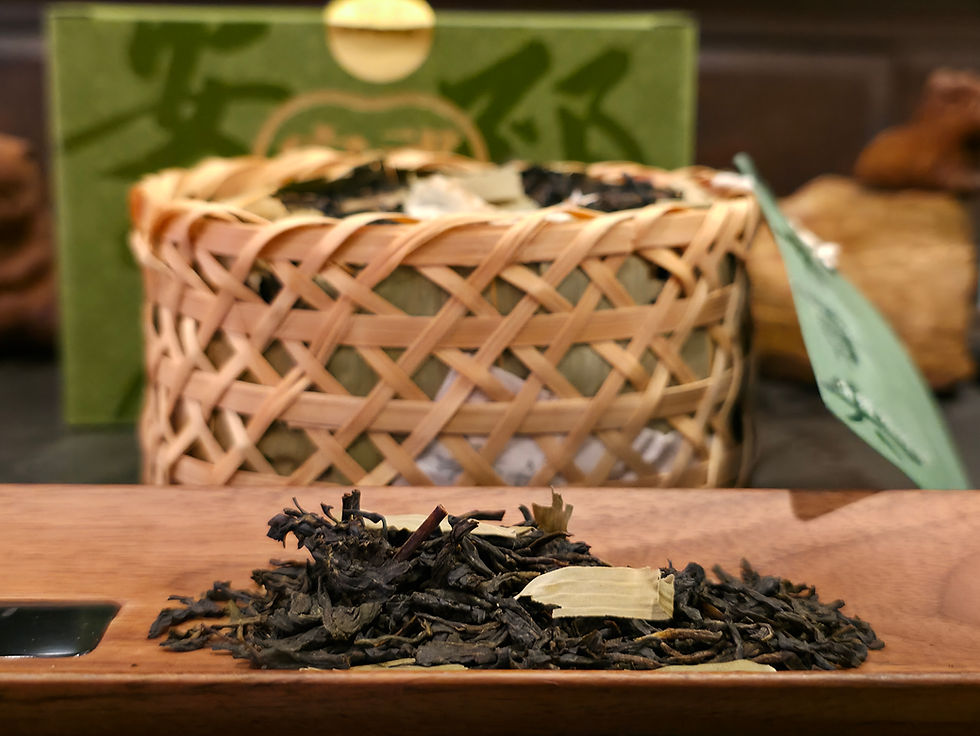
What is in An Cha?
An Cha is a delicious and unique heicha from Anhui Province that combines, in essence, the best of green tea, black tea, and heicha– it’s partially fermented, like a heicha, charcoal roasted, and mildly oxidized similar to a green tea at times. An Cha is NOT the same as Anhua heicha, which is something people commonly think when I mention An Cha. NOR is it the same as Qimen black tea (keemun black tea). Let’s get the naming convention out of the way, first, though. Linguistically, there are two closely-related names: for the first, the Chinese characters are 六安, or “Liù ān”. The first character has two pronunciations: Liu, which is more common and the form often used in the romanization of the word, and Lu, which is the one that’s actually used where this tea is grown. So the real name is Lu An, not Liu An- which is why there is a common misconception or mix-up between lu an and liu an guapian, a green tea also from Anhui. So, like a convoluted game of telephone, Western vendors have parroted each other to the point that this confusion is commonplace for the market. However, another common name for this is 安茶, or “Ān chá.” Again, due to the marketing mix-ups, many vendors will sell An Cha as Liu’An, or Liu’An as An Cha, essentially selling them as the same tea- but this is not the case, which we will cover shortly. Now, one important thing to note, too: one of the key production regions for Qimen An Cha is Luxi Township ("芦溪乡," LuXiXiang), which is shown on a map below. It is entirely possible as well that the name of the town, "LuXi," was shortened to just "Lu," contributing more to the confusion, though this is less likely. You can see the relative area where this tea is produced- rugged, mountainous, and full of winding rivers, creating a highly humid area. If you zoom in, you can actually see some of the tea fields along the riverbanks.
Other historic names to add to the confusion are Huicha, Ruanzhi Tea, Lizai Tea, Huiqing, and Lao Liu'an- all names for the same type of tea. So, you can see how easily the confusion would arise! Additionally, in Cantonese-speaking regions, you may also see it being sold as 六安, or luk on (luhk on), the Cantonese version of Liu An. An Cha was extremely popular in Southern China and Southeastern Asia, especially during the early 20th century, especially valued for its medicinal benefits. Unfortunately, production of An Cha in Anhui halted in 1937 with the Japanese invasion of China during the Second Sino-Japanese War due to the traditional trade routes being disrupted– this meant that the tea itself nearly disappeared, especially commercially, as there was no longer a demand for the tea. As a caveat, commercial production was halted, though small-scale local production may have persisted. After all, if you can’t ship the tea out or sell it, the incentive to continue production is next to nothing for many farmers. An Cha production itself would not resume until the 1980s and 1990s, but the revival of it was quite the process.
Reviving an Ancient Tradition
Early efforts to reproduce An Cha began in 1983, spurred by Mr. Guan Fenfa (關奮發), a well-known tea master from Hong Kong. According to one of the best-documented stories about the revival of An Cha, Mr. Guan Fenfa wrote a letter and sent a basket of aged Ancha tea from Hong Kong in search of it:
“Mr. Guan Fenfa's letter expressed his hope that the tea-producing region could recreate the aroma of tea from half a century ago. (寻访被遗忘的安茶 含祁门《安茶事纪》高清视频, “Searching for the Forgotten Tea of Anshan, Including Qimen: A High-Definition Video of "Chronicles of Anshan Tea")
Unfortunately, even with the basket, early efforts at producing An Cha were muddled and in vain- at that time, the early 1980s, no farms in Qimen produced An Cha in the way it was done historically. Farmers saw the early tea leaves and the faded tea tickets and assumed it was just a coarse, old tea. They collected some scraps of material they had, based on their imagination, to make An Cha, but they could never replicate the taste of An Cha properly- until 1991 and 1992, that is.
A stack of An Cha baskets An Cha in a Basket An Cha baskets and Brewed Tea
Lu’An Basket Tea vs. An Cha:
In addition to the naming mix-up, there’s a historical difference between the two teas, one that many struggle to grasp, and understandably so – both teas are dark, ageable, and historically packed in bamboo baskets. In the clearest way possible, the best way to explain this would be that Qimen An Cha and Liu’An basket tea share the same family tree, of sorts (commercially, with some processing similarities), and were once marketed under the same Lu'An/liu’an name, but modern scholars and producers treat the teas as two related yet distinct regional dark teas. Now, I know that can be confusing, so let’s dive into the “why” behind this.
In the Ming and Qing dynasties, Liu’an/Lu’An was a major trading region for tea- merchants from Liu’an exported tea widely and the term Lu’an basically became a broad commercial label rather than a precise geographic or processing category. We also see An Cha referenced as “qingcha,” or “soft-branch tea” in Ming dynasty records, specifically the local QiChang records, which date to about the 1700s, but this refers more likely to the leaf grade used- soft, tender buds and young leaves were selected in the production of An Cha.
Qimen An Cha developed in the Qimen/Huizhou region and was inspired by the Liu’an tea trade, but was created using local material, leaf grade, and its own processing compared to the teas in Lu’an. Given that it was also packed into baskets and sold as a dark tea, this misunderstanding of the two tea types naturally arose and has stayed around since.

Processing An Cha:
Processing An Cha is extremely technical and time-consuming, taking approximately 8 months to complete, with a total of 14 major processing steps. Now, as a caveat, let me mention something that has been a source of major confusion this entire time. If you begin researching An Cha production, even on the Chinese internet, you will come across 9/10 sources that say that An Cha does not undergo wodui. This is technically true, but it does undergo some form of piling during processing. During my research, I managed to find a treasure-trove of information: a patent from 2014 on the modern production of An Cha, which listed every single step in meticulous detail. So, let’s get into the 14 steps.
First and foremost, while higher altitude tea farms are more popular for other teas, like puerh, An Cha is grown rather low– the material used to make quality an cha generally comes from farms at or below 800m (2624ft). These farms also tend to be located near the river, or in an area with higher humidity. The raw leaves (“毛茶,” máochá) are harvested in the spring and early summer (between Grain Rain (谷雨) and early June), and are picked to a standard of one bud and one leaf to one bud and four leaves. Interestingly enough, An Cha is a blend of the spring and summer pickings, at a usual ratio of 100 jin (60kg, 132.27lbs) of spring material to 20 jin (12kg, 26.45lbs) summer material. These leaves then undergo a wilting period, where the leaves are placed in a 25C (77F), high-humidity environment (80% or higher) overnight, turned 2-3 times during the process, and left to wither slowly for about 10 hours. The farmers want the leaves to reach about 67-68% moisture content, or about an 11-13% reduction in weight, during which the grassy, greener aromas disappear and the distinct an cha aromas start to present themselves. After wilting, the leaves are blanched or steamed, depending on the producer, to stop the enzymatic oxidation of the tea. This is the 杀青 (sha qing), or “kill green” step. In most modern An Cha production, the kill green occurs in a modern blanching machine, similar to other kill green processes for other teas.

The next step is the rolling period, where the warm, withered leaves are rolled in a rolling machine for approximately 20-25 minutes. The rolled leaves are laid out on bamboo mats and left to sun-dry for 2-3 hours, depending on the relative humidity indoors, temperature, as well as the tenderness of the leaves after rolling and the thickness of the leaves when spread out on the mat. Now, during rainy or colder days, this sun-drying process, as well as the next stage of fermentation, can occur indoors with charcoal fire and modern climate control methods- this can also be considered the same as a withering room (“萎凋间,” “Wěi Diāo Jiān”) for indoor withering.
After rolling and drying, the seventh step is to undergo a slight fermentation period, where the rolled and dried leaves are shaken off the mat, then piled up individually. This is NOT wodui (“渥堆,” “Wò duī”), or wet-piling. During this step, the leaves are placed into temperature-controlled piles, kept below 42C or 107F. These piled leaves are meticulously turned once every 1.5hrs to increase oxygen exposure inside the piles and to reduce the temperature, which in effect accelerates fermentation and promotes even, uniform fermentation. This entire piling process takes around 6 to 6.5 hours, with a half hour variability between piling.
After fermentation, the leaves are then re-kneaded to tighten the leaves, kneaded for about 8-10 minutes. When the leaves have been re-kneaded, they must undergo the drying process. Drying takes a substantial amount of time as the leaves have to be baked 3 separate times to fully dry. These bakings decrease in temperature with each subsequent bake- starting at 130C, then dropping to 110C, and finally being baked at 90C. After drying, the leaves are sorted- this removes stems, broken leaves, dust, and other debris from the tea via a tumbling screen. Air can also be used, similar to winnowing husks from grains, with the tea leaves, to blast debris and dust off the whole leaves. Once sorted, the leaves undergo the most unique stage of an cha production yet: night dew.

So…what makes an cha heicha?
In order for a tea to be classified as heicha, it has to undergo some form of post-fermentation, or hòu fāxiào (“後發酵”). Unlike most heicha, an cha does NOT undergo wodui (“渥堆”, “Wò duī”), or wet-piling fermentation, and instead skips that step in place of another, more unique processing technique: night dew (“夜露,” “Yèlù”).
YeLu is complex and the name makes it sound more mysterious than it is. In reality, YeLu is just another stage in processing the tea that occurs during the Báilù “白露” solar term in autumn, or around September-October. The makers leave the charcoal roasted, half-processed leaves and lay them directly on a bamboo mat, leaving them outdoors overnight. In the most traditional processing the leaves must be brought back inside at sunrise and turned over regularly. This step acts as a sort of wet-piling and allows the processed leaves to absorb the moisture from the atmosphere, which according to tradition removes bitterness from the tea and creates a smoother taste. In reality, this method likely developed from the processing methods of herbs for traditional Chinese medicines, as Qimen was historically known for being an area renowned for Imperial physicians, healers, and the like. The belief is that the charcoal roasting contributes yang energy to the tea, and the YeLu processing contributes yin energy to the tea, making for a tea that balances the body. We’ll go over this cultural significance more here in a bit, but for now, let’s get back into processing the tea.

Sometimes, in processing An Cha, we will also see a repetition of YeLu, alternated twice between the night dew exposure and charcoal firing, which is known as Er Lu,二露 “second exposure,” a more time-consuming process that results in a gentler tea with a rounder, fuller flavor than with a single cycle of night-dew
After YeLu, the tea leaves are steamed for 2.5-3 minutes at a time, enhancing the aroma of the tea leaves and making them pliable for packaging. For packaging, the steamed leaves are then packed into woven bamboo baskets before being roasted a third and final time, which locks in the aroma and ensures longevity in the tea, giving it a soft, roasted flavor. This final drying is a slow, low dry, generally over charcoal or a specific drying rig, roasted at a temperature of about 60±2℃ for a total time of about 28±2h, meaning that this final drying stage can take upwards of 30 hours to complete.
An Cha in traditional bundles of 6 (1,500g total) An Cha basket Ruoye Leaves An Cha with Leaves cut back for drinking
Packaging
An Cha comes packed in a beautiful and unique packaging- small, woven bamboo baskets with the tea wrapped up like a precious treasure. The processed tea leaves are placed into the bamboo baskets, which are lined with the ruoye leaves, Ruoye (箬叶, Indocalamus tessellatus “large leaved bamboo”) leaves are used to pack the teas, with ruoye being a more fragrant bamboo species that imparts a slightly aromatic floral note to the tea that complements the tea leaves, known as 箬叶沉香 (Ruò yè chénxiāng, “bamboo/reed leaf incense”). The bamboo leaves must be fresh in order to retain the fragrance of bamboo leaves, which means meticulous sorting is required. Here is a great video from 小师姐评茶 ("Little Sister Tea Review"), who actually showcases each step in producing An Cha, and who I was able to purchase the 2024 An Cha basket from.
How to Brew An Cha
An Cha is a very forgiving tea. There are multiple ways you can steep it, though I prefer gongfu style myself for the fullest flavor profile and the relaxing experience gongfu provides. Here are three methods of preparation for an cha:
Gongfu style: Take a 100ml gaiwan or yixing teapot and warm it with boiling water. The ratio for brewing varies between 1:10 to 1:35 (i.e.: 1 gram leaf for every 10ml water), but I like to take 5g of the leaves and 1g of the bamboo for my 100ml gaiwan. Use boiling water (100°C/212°F) and for the first two steeps, brew the tea for 10 seconds. For each additional steep, add 7-10 seconds.
Thermos-style brewing: This results in a richer brew overall and is great for days where you just want to have a warm cup of tea without the commitment to gongfu brewing. To brew thermos style, we start with a much higher ratio of 1:300, or 1g for every 300ml of water the thermos will hold. Add the tea to the thermos, then pour in the boiling water, and let it steep for several hours before drinking- generally at least 1-2 hours for the first steep. When a third of the tea remains in the thermos, refill it with boiling water to continue brewing, extending the steep time for each additional thermos-full.
Western Style: Again, we’ll take a higher ratio of leaves to water, or 1:300, adding the leaves directly to your steeper or your mug, then adding boiling water and steeping for 5-7 minutes. Repeat the process, extending the brew time by 2-3 minutes each subsequent steep, refilling the mug when about a third of the tea is left inside.
2024 An cha (lighter, brighter yellow) 2000 An Cha (darker red, deeper flavors) 2024 An Cha Brewed 2000 An Cha brewed
What’s it taste like?
Aromatically, An Cha is mellow, earthy, sweet, and chocolatey- it’s a unique aroma with a subtle smokiness underlying from the different firings. Particularly, younger An Cha will exhibit a stronger, more noticeable 炭焙香 (tàn bèi xiāng, “charcoal-roast aroma”) as there has been less time for the tea to rest and for the roasting flavors to meld and dissipate. Another characteristic can be the 火气 (huǒ qì), or fire characteristic/fire energy, a distinct note that resembles a sort of slight sharpness or edge to the roast, almost like a slightly metallic tang- if you notice the huǒ qì, it would be best to let the tea rest for a bit longer before drinking again- generally for a few days or weeks. Generally speaking, An Cha benefits from a minimum of 1-3 years of age before drinking, to fully dissipate that roast and instead transform into something truly spectacular; the older the an cha, the better the flavors are. As you can see above, the tea on the left is a 2024 basket of An cha, and the tea on the right is An Cha from 2000. Note the impact of age on the color of the brew, changing from a light gold to a darker red.
Flavor wise, An Cha is incredible and difficult to describe without having tasted it. It is a mellow, sweet, and refreshing tea with a thick and smooth mouthfeel. The flavor is nuanced and layered, with notes of bamboo, roasted grain, dried fruits, cocoa husks, and a clean, pleasant earthiness (not musty or strong like a liu bao). When brewed with pieces of the ruoye leaves, the an cha develops a unique rice dumpling note to it, as well as a prominent sweet, clean, fresh and woody flavor. Similar to puerh, An Cha does great with age and is considered a treasure that will last, with flavors developing and becoming deeper with time. An Cha is a cozy, warm and comforting tea and in my opinion can be similar to a well-stored aged sheng puerh but more subtle; experience wise, the calming energy of brewed An Cha almost warms the body from the inside out, and the leaves themselves present a lovely huigan (“回甘,” “returning sweetness”) in the mouth and throat after drinking. You’ll also notice strong saliva production, or 生津 (shēng jīn)- something you will generally notice with aged or quality puerh.
Cultural Significance
An Cha has a lengthy and storied history, from production to benefits within Traditional Chinese Medicine (TCM). Written records directly date An Cha as being at least 300 years old, with the earliest official record of An Cha being during the reign of Emperor Yongzheng of the Qing Dynasty (~1725). Production of An Cha commercially stopped in 1937 due to the Japanese invasion of China.
An Cha has long been regarded as a medicinal beverage within TCM and was especially popular in Southern China and Southeast Asia. Due to its unique processing, it has long had the honorifics of “holy tea” or “sacred tea,” given its potency in TCM for reducing and eliminating dampness and balancing the body’s energies- it was even used as a guiding herb (Shi 使), an ingredient in TCM that helps increase the effectivity of the herbal remedies, “guiding” the properties to certain meridians or organs in the body, as well as helping to balance the blend overall. As a disclaimer, this is NOT medical advice and should NOT be taken as such. I am solely relaying the information in a cultural sense, where TCM views An Cha as having the capabilities to “stop bleeding, detoxify and reduce swelling, sterilize, quench thirst and promote body fluid production, and dispel miasma and evil spirits” One story, related in the letter from Mr. Guan Fenfa when attempting to revive An Cha,
In the Hong Kong and Guangdong areas, fishermen who suffered from abdominal bloating after drinking seawater would boil tea leaves on a stove, drink a bowl, and be cured. A century ago, doctors in Lingnan used Ancha tea as medicine to cure a plague epidemic in Guangdong. Because of its medicinal properties, Ancha tea was called "holy tea," but it has long been lost to history, with only a small amount of aged tea remaining. (9)
One of the most famous An cha companies is Sun YiShun, which has been around since the 1700s. One of the men responsible for modern an cha production and the revival of the tea, Wang Zhenxiang (汪镇响当), head of Sun YiShun, recalled this story about the history of An Cha production, which mentions one of the earliest records of medicinal use:
During the reign of Emperor Yongzheng in the Qing Dynasty, there was a nunnery in a mountain village in Yixian County. Beside the nunnery grew an old tea tree, which flourished and became beautiful thanks to the watering and care of the locals. In 1725, the nun Miaojing picked some leaves and chewed them, finding them surprisingly sweet. She then placed them on a stone slab to dry, and casually kneaded them a little. That evening, she forgot about them. After a night of mist and dew, the next day, she saw that the tea she had kneaded the day before had turned black, but the leaves were still soft. So she wrapped the tea in bamboo leaves from the stream and hung it outside the nunnery to dry, and later hung it on a pillar inside the nunnery. Several years later, one day she reopened the container and smelled a dusty odor. Seeing that the tea was still black, she felt that this tea must be special, so she steamed and dried it for future use. Years later, Abbess Miaojing fell ill and remembered this tea. Indeed, it was miraculous; after brewing and drinking it, she felt refreshed and her illness was cured. She then mobilized the nuns to collect and process the tea throughout the mountains and fields, distributing it widely. Because the tea had certain medicinal value, it became popular in the area. (9)
So, culturally, An Cha serves as a living link to the past and a success story for reviving and revitalizing ancient historical cultural practices. To drink An Cha is to slow down and listen to time, to let a nearly forgotten story unfold sip by sip. It is, fittingly, the tea that time forgot—until now. We are sipping history, tasting a legacy that almost completely disappeared, each cup becoming a quiet reminder that some histories are not lost—only waiting to be remembered. Though the tea itself remains niche and difficult to obtain, especially in the Western market, its rarity only reinforces what makes An Cha so rewarding and unique: a forgotten history rediscovered, one cup at a time. I hope that if you search An Cha out, you’ll fall under its spell too, experiencing for yourself the quiet joy of tasting a piece of history and in the process, discovering a new favorite tea. Cheers, friends!
TL;DR of An Cha:
An Cha is NOT the same as Anhua heicha, nor Qimen black tea.
An Cha production nearly disappeared in 1937 and was revived in the 1980s-1990s.
An Cha and Liu’An basket tea are both obscure, relatively-unexplored teas in the Western market, often confused or mislabeled, and many available descriptions online are incomplete or inaccurate.
An Cha is a unique heicha from Anhui Province that is partially fermented (heicha), charcoal roasted, and mildly oxidized.
Naming and regional mix-ups (Lu’An vs. Liu’An, An Cha vs Liu’An, Luk On, Huicha, etc.) have created widespread confusion in the tea market.
Culturally significant, yet almost forgotten, An Cha has a recorded history of at least 300 years, valued for medicinal properties in Traditional Chinese Medicine and called “holy tea” by some.
Qimen An Cha and Liu’An basket tea share the same family tree but are two related yet distinct regional dark teas.
Traditional An Cha production is highly technical, involving 14 steps over 8 months, including a unique night dew (YeLu) stage instead of typical wet piling.
Traditionally packed in woven bamboo baskets and wrapped in bamboo leaves to stabilize the tea for long-term aging and storage.
Sources (cited with numbers above for ease of reference):
1.) 木舟茶事 ("Wooden Boat Tea Ceremony") "Lu'An Basket Tea," https://zhuanlan.zhihu.com/p/150016045
2.) An Cha, "https://baike.baidu.com/item/%E5%AE%89%E8%8C%B6/1474034"
3.) 懂茶帝 ("Tea Connoisseur") "What is the Relationship between Lu'An guapian, Lu'An Basket Tea, and An Cha?" https://zhuanlan.zhihu.com/p/29494633
4.) Chawang Shop, https://www.chawangshop.com/hei-cha/anhui-liu-an-cha.html
5.) "Determination and difference analysis of aroma compounds in An-Tea with different aging time," Xinsong She et al 2019 IOP Conf. Ser.: Earth Environ. Sci. 358 022065, https://www.researchgate.net/publication/368083971_Determination_and_difference_analysis_of_aroma_compounds_in_An-Tea_with_different_aging_time
6.) "A Processing Technique for Ancha Tea," https://patents.google.com/patent/CN103749753A/zh
7.) Sunrise Tea 888, "室內萎凋" (Indoor Withering), https://www.sunrisetea.tw/blogs/news/153554#:~:text=%E5%AE%A4%E5%85%A7%E8%90%8E%E5%87%8B%E6%98%AF%E5%9C%A8%E8%8C%B6%E8%91%89,%E4%BD%B3%E7%9A%84%E5%93%81%E8%B3%AA%E5%92%8C%E9%A2%A8%E5%91%B3%E3%80%82
8.) China Tea Spirit, "Qimen An Cha: A Mysterious Hei Cha with a Rich History," https://www.cnteaspirit.com/qimen-an-cha-a-mysterious-hei-cha-with-a-rich-history/?srsltid=AfmBOort6e11qsQUVl-q3Cqlu1QB2zXp5q5jWJFlbzIHe7Lr5zM3_hcb
9.) Madam Cha, "The Birth of a Basket of AnCha Tea," https://www.youtube.com/watch?v=Z87Sz0lJREQ
10.) "Searching for the Forgotten Tea of Anshan, Including Qimen: A High-Definition Video of "Chronicles of Anshan Tea," https://www.qmhtea.com/tea590.html
11.) Sun, Yuning, Sichen Li, Jie Cao, Huihui Peng, Yuexin Liu, Fuqing Bai, Chuanyi Peng, Huimei Cai, Zhongwen Xie, Daxiang Li, and et al. 2025. "Digestion Characteristics and Probiotic Activity of An Tea Polysaccharides: Promoting Lactobacillus and Bifidobacterium In Vitro and In Vivo" Fermentation 11, no. 2: 97. https://doi.org/10.3390/fermentation11020097
12.) Xu, J.; Wang, S.; Yao, T.; She, X.; Gan, Z. "Vertical Distributions and
Bioavailabilities of Heavy Metals in Soil in An-Tea Plantations in Qimen
County, China". Processes 2022,10, 664, https://www.mdpi.com/2227-9717/10/4/664


Comments